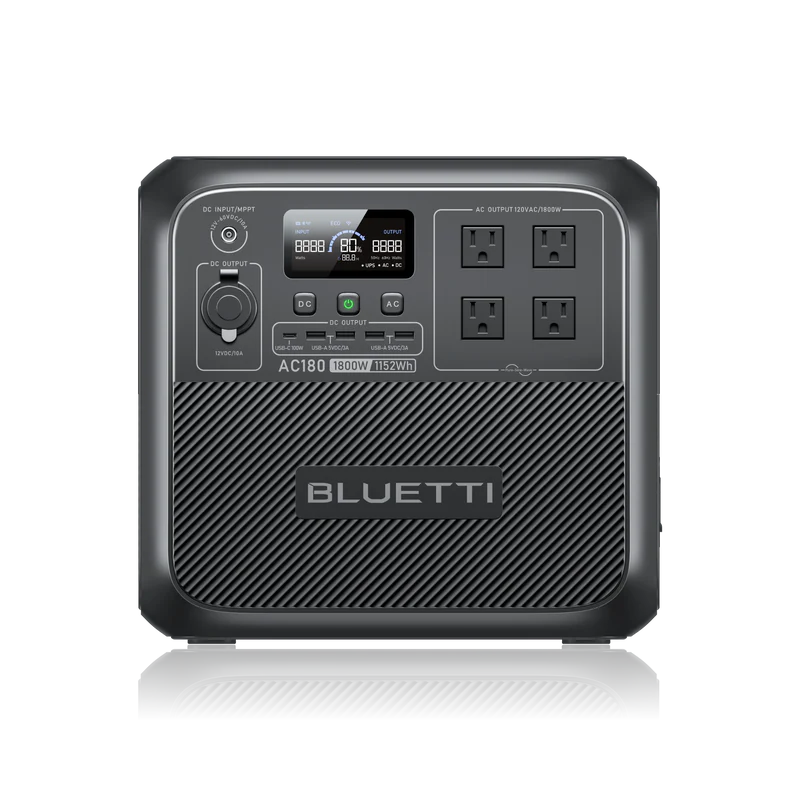
The short version
A useful middle ground.
Know its boundaries.
The AC180 combines a substantial inverter with a smaller energy reserve than the 2kWh stations often chosen for longer backup. That balance makes sense when you need to run a demanding appliance briefly, then recharge between sessions.
For a laptop, lighting, or other modest loads, the battery can support considerably longer use. For a 1,500W heater, the same reserve lasts well under an hour in our planning example. Buying on output watts alone misses this difference.
Review method: This assessment uses BLUETTI’s official listing and user manual. We have not conducted hands-on testing. Charging and cycle-life figures are manufacturer claims; runtime figures below are calculations. No measured noise, efficiency, or performance score is claimed.
Reasons to consider it
- 1,800W rated pure sine wave AC output.
- Up to 1,440W wall charging.
- LFP battery and advertised five-year warranty.
- Four US AC outlets and 100W USB-C.
- Solar input up to 500W.
- Bluetooth monitoring and controls.
Tradeoffs to weigh
- Heavy for a roughly 1kWh station.
- Limited runtime for continuous high loads.
- No integrated expansion-battery connection.
- Power Lifting has specific load restrictions.
- Bluetooth requires a nearby connection.
- Solar and battery accessories add cost.
Know what you are buying
The important specifications.
| Battery | 1,152Wh · LiFePO₄ (LFP) |
|---|---|
| Rated AC output | 1,800W total · Four 120V outlets on the US model |
| Power Lifting | Compatible resistive appliances rated up to 2,700W; not normal 2,700W output |
| USB and DC | 100W USB-C · Four USB-A ports · 12V/10A car outlet · Up to 15W wireless charging |
| AC input | Up to 1,440W in Turbo charging mode |
| Solar input | 500W maximum · 12–60V open-circuit voltage · 10A maximum |
| App connection | Bluetooth |
| Internal expansion | No direct integrated expansion connection |
| Weight* | About 35.3 lb (16 kg) in the manual and comparison chart |
| Dimensions | 13.39 × 9.72 × 12.48 in (340 × 247 × 317 mm) |
| Cycle life | 3,500+ cycles advertised by BLUETTI; not a calendar-life guarantee |
| Warranty | Five years advertised; verify terms for your purchase |
Sources: BLUETTI US product listing and AC180 manual. *The listing also quotes 37 lb / 17 kg in its descriptive text. Confirm the exact unit’s weight if lifting is a concern. Regional outlet layouts differ.
Match the load
1,800W is the number
to plan around.
The four US AC outlets share the station’s output allowance. Adding outlets does not multiply available power. Check the combined electrical demand of everything you intend to run, including startup requirements for motors and compressors.
A 1,500W heater is below the normal 1,800W AC ceiling when used alone; it does not need Power Lifting on that basis. A microwave’s cooking-wattage headline can be lower than its electrical input, so read the input specification before choosing a station.
For a fridge, confirm startup compatibility and measure energy consumption over a representative day. A compressor’s running-wattage number alone cannot establish either startup success or how many hours the battery will last.
Refilling the battery
Fast from the wall.
Flexible away from it.
BLUETTI advertises 0–80% charging in 45 minutes using Turbo charging. This is a manufacturer claim under suitable conditions, not a fixed time for every session. Temperature, battery state, settings, available supply, and connected loads affect charging. Standard and Silent charging modes provide alternatives to Turbo.
For solar, check panel open-circuit voltage against the 12–60V input range, including its increase in cold weather. The input limit is 10A and 500W. A panel’s wattage alone does not establish compatibility, and real harvest depends on sun, temperature, orientation, and shading.
A suitable array rated above the input power ceiling may produce more useful energy in weaker light, but the station still cannot accept more than its limits. Do not exceed the electrical specifications to chase a higher panel-wattage number.
Vehicle charging is also supported. A normal car socket is much slower than Turbo wall charging. BLUETTI’s current listing includes AC180 vehicle-charger bundles; check the charger’s supported connections and installation requirements rather than assuming the AC180P is the only compatible option.
References: US listing and manual charging sections. Confirm cables and accessories in the exact bundle you order.
Calculated, not measured
How long could it run?
Our planning examples use 90% depth of discharge, 85% conversion efficiency, and a 15W station operating allowance. These assumptions draw on the AC180 manual’s example formula. We apply the overhead consistently here, including higher loads; actual results vary.
| Average AC load | Estimated runtime |
|---|---|
| 20W | 25.2 hours |
| 60W | 11.8 hours |
| 100W | 7.7 hours |
| 120W | 6.5 hours |
| 200W | 4.1 hours |
| 700W | 1.2 hours |
| 1,000W | 0.9 hours |
| 1,500W | 0.6 hours |
Formula: 1,152 × 0.90 × 0.85 ÷ (average AC load in watts + 15). Assumes a full starting battery and no incoming charge. This is an illustrative AC model, not a guarantee or a USB/DC runtime calculation.
Use average demand for cycling appliances. For example, measuring daily fridge energy gives a better starting point than multiplying a single running-wattage reading by 24 hours. There is no universal fridge-runtime multiplier. Startup compatibility remains a separate check.
Battery condition, temperature, inverter losses, enabled outputs, and ECO settings can change the outcome. Incoming solar can extend operation, but count on realistic energy collection rather than the panel’s advertised peak output.
Method reference: AC180 manual, runtime examples.
Understand the connection
External charging.
Different from expansion.
The AC180’s internal nominal capacity remains 1,152Wh. BLUETTI lists charging from B80, B230, and B300 batteries through supported Power Bank arrangements with the appropriate separate cable.
This transfers energy into the station through its charging input; it is different from a directly integrated expansion pack. Adding two batteries’ nominal Wh figures does not tell you the energy delivered to appliances. Cable limits, charging limits, and conversion losses matter.
Choosing between siblings
AC180 or AC180P?
| Model | Nominal battery | AC output | Solar input |
|---|---|---|---|
| AC180 | 1,152Wh | 1,800W | 500W maximum |
| AC180P | 1,440Wh | 1,800W | 500W maximum |
The AC180P adds 25% nominal energy while keeping the same rated AC output in BLUETTI’s comparison chart. It is worth pricing when longer runtime matters. Neither capacity figure increases the appliances’ permitted power demand.
Compare current prices, warranty terms, and included accessories. We do not assume the AC180 is always the cheapest option or the best value per Wh. For longer backup, compare a larger-capacity station against the cost and complexity of external charging batteries.
Before ordering
Choose the right bundle.
Confirm the AC180 model, US outlet layout, included charging cables, solar-panel compatibility, shipping, return terms, and warranty. Compare the station-only price with bundles containing accessories you will actually use.
Our shopping link opens BLUETTI’s store. Select the AC180 there and verify the current offer.
Browse BLUETTI ↗Affiliate link · Opens the BLUETTI storeQuestions answered
AC180 FAQ.
Can it run a refrigerator overnight?
Possibly, but there is no universal overnight guarantee. Check compressor startup and measure the fridge’s average energy use. Temperature, cycling, and battery settings affect runtime.
Does Power Lifting supply 2,700W normally?
No. It operates suitable resistive loads at reduced power. Plan ordinary appliance use around the normal 1,800W AC rating and verify startup requirements separately.
Can I add a B80 expansion battery?
A supported B80 and cable can charge the AC180 in Power Bank mode. This is external charging, with transfer losses and input limits; it does not change the internal 1,152Wh capacity.
Does the app work over Wi-Fi?
The AC180 documentation lists Bluetooth app control. Plan on a nearby connection rather than assuming remote Wi-Fi access.
Is a 1,500W heater a good backup load?
It is within the normal output rating when used alone, but it consumes energy quickly. Our illustrative calculation gives roughly 35 minutes of continuous use. Actual operation can differ.
Is the review based on hands-on testing?
No. It is an independent assessment of official specifications and documentation. Runtime figures are calculated scenarios, not measured results.
Sources and review method.
Official documentation checked September 17, 2026. Follow the current manual for the exact regional model and firmware. Product image supplied by BLUETTI.
- BLUETTI AC180 US listing — US outlet layout, charging claim, warranty, accessories, and AC180P comparison.
- AC180 user manual — dimensions, weight, input limits, Bluetooth, and charging modes.
- AC180 manual with runtime examples — calculation assumptions.