The short version
Buy for the system you need.
Size the loads first.
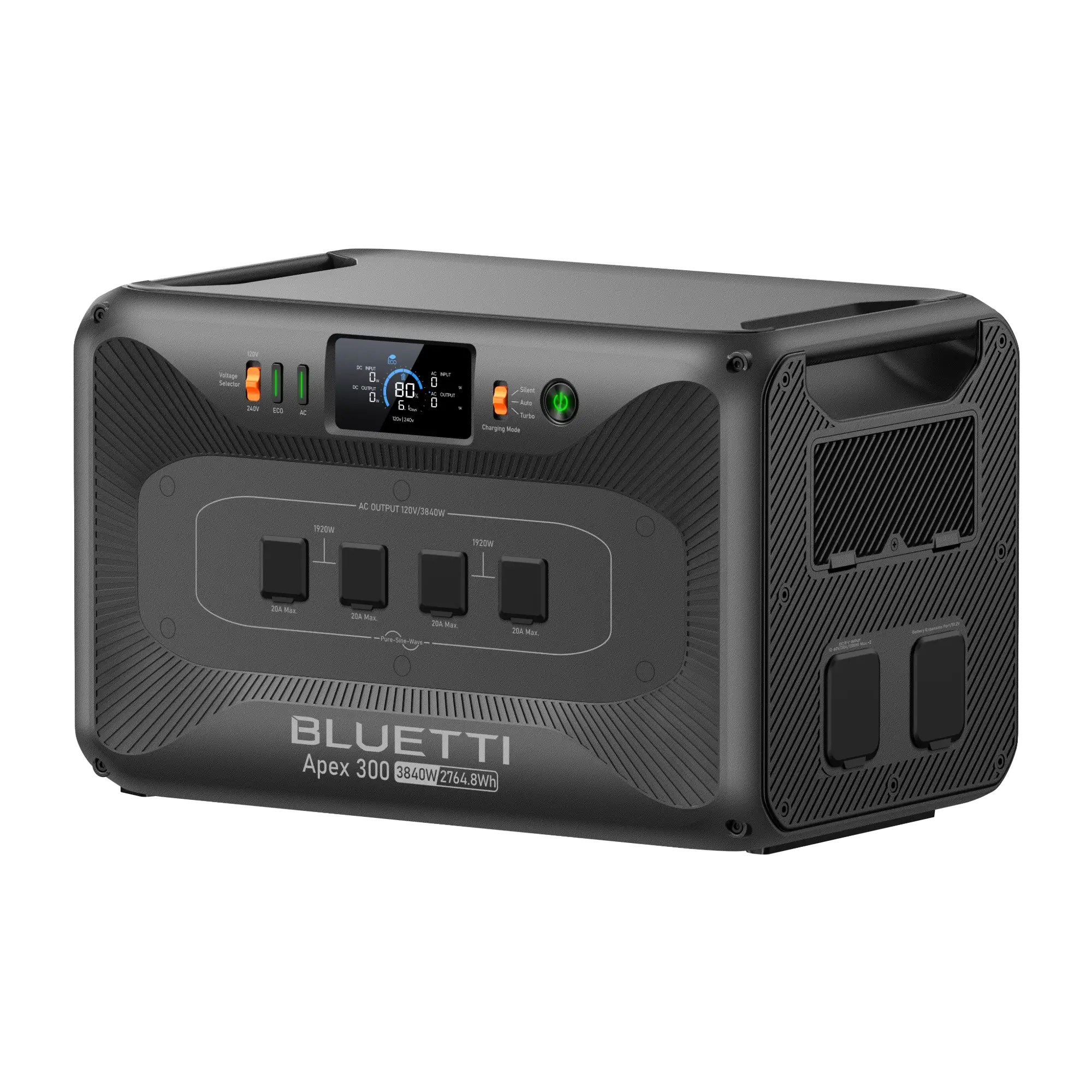
The APEX 300 sits between a self-contained portable station and a more involved home-backup installation. Its built-in battery lets it operate on its own, while expansion batteries and compatible hubs create several ways to scale. Those choices are useful only when their cost, electrical requirements, and physical footprint fit your plan.
Dual-voltage output expands the list of potentially compatible appliances, but voltage is only one requirement. A well pump, air conditioner, or EV charging setup must also fit the continuous rating, startup demand, outlet limits, and installation configuration. A 240V socket does not mean unlimited household power.
Review method: This assessment uses BLUETTI’s US documentation and published specifications. We have not bench-tested this model. Manufacturer ratings and illustrative calculations are identified below; no measured performance score is assigned.
Reasons to consider it
- Simultaneous 120V/240V output on the US model.
- 3,840W rated AC output and an integrated LFP battery.
- Expansion batteries can increase stored energy.
- Two built-in solar inputs, up to 2,400W combined.
- Parallel systems offer higher total AC output.
- Manufacturer-listed five-year warranty.
Tradeoffs to weigh
- About 83.8 pounds before adding batteries.
- USB and DC outputs require an optional Hub D1.
- Higher charging figures depend on the connection and accessories.
- Shared outlet and total-output limits still apply.
- Home-circuit integration adds equipment and installation costs.
- UPS behavior depends on mode and outlet configuration.
Know what you are buying
The important specifications.
| Base battery | 2,764.8Wh · LiFePO₄ (LFP) |
|---|---|
| Rated AC output | 3,840W total |
| US output voltage | 120V and 240V simultaneously, with the appropriate configuration |
| Power Lifting | Compatible pure resistive loads rated 3,840–7,680W; reduced operating power |
| AC outlets | Four front 120V outlets, one 120V TT-30 RV outlet, one 120V/240V 50A receptacle; shared limits apply |
| USB / DC outputs | Optional Hub D1 required |
| Built-in solar inputs | Two XT60 inputs; 1,200W each, 2,400W combined; 12–60V and 20A maximum per input |
| Ordinary AC input | 120V / 15A, 1,800W maximum for charging and bypass together |
| Maximum AC charging | Up to 3,840W via a suitable source and supported connection |
| UPS transfer | 0ms or approximately 20ms, depending on mode and outlet configuration |
| Weight | About 83.78 lb (38 kg) |
| Dimensions | 20.67 × 12.87 × 12.6 in (525 × 327 × 320 mm) |
| Cycle-life claim | Up to 6,000 cycles with 80% capacity retention, according to BLUETTI |
| Warranty | Five years listed for the US station; check accessory and battery terms separately |
| Environment | IP20; keep dry. Charging: 32–104°F (0–40°C). Discharging: −4–104°F (−20–40°C). |
Sources: BLUETTI US support and manual downloads, US user manual, and current US product listing. Follow the latest manual for your exact hardware and firmware.
Output and connections
Dual voltage.
A shared power budget.
Simultaneous 120V/240V output is the APEX 300’s main distinction from smaller all-in-one BLUETTI stations. It can supply compatible 240V equipment alongside 120V devices. That makes it relevant to some RV and home-backup plans, but the base unit’s 3,840W rating still governs total AC demand.
The four front outlets are arranged in two pairs. The US manual gives each pair a 1,920W limit, with 3,840W maximum across the front group. The TT-30 RV outlet is specified at up to 3,600W, while the 120V/240V receptacle is limited by the station’s 3,840W output. These figures are not separate allowances that can be added together.
The 7,680W Power Lifting mode is for supported pure resistive loads, such as certain heating elements. The manual says their operating power is lower than their rated power in this mode. Do not use that figure as a universal surge rating for pumps, compressors, or power tools.
There are no built-in USB or DC charging outputs on the station. Budget for a compatible Hub D1 if USB-C, USB-A, or DC loads are part of the plan. This is a meaningful difference from a smaller station with those ports already included.
References: US manual, sections 5.3 and 13; BLUETTI’s load-compatibility guidance.
Scaling the system
More batteries add energy.
More stations add output.
A B300K adds 2,764.8Wh of nominal capacity. A B500K adds 5,120Wh. Expansion batteries increase energy storage and potential runtime; they do not turn one APEX 300 into a higher-rated AC inverter. To increase normal system output, BLUETTI offers supported two- and three-station parallel configurations with the required hub and cables.
| Configuration | Nominal capacity | Rated system AC output |
|---|---|---|
| One APEX 300 | 2,764.8Wh | 3,840W |
| One APEX + one B300K | 5,529.6Wh | 3,840W |
| One APEX + two B300K | 8,294.4Wh | 3,840W |
| One APEX + six B300K | 19,353.6Wh | 3,840W |
| One APEX + one B500K | 7,884.8Wh | 3,840W |
| One APEX + two B500K | 13,004.8Wh | 3,840W |
| Two APEX stations + Hub A1 | 5,529.6Wh before expansion batteries | 7,680W |
| Three APEX + eighteen B300K + supported hub system | 58,060.8Wh (about 58.1kWh) | 11,520W |
Capacity totals are arithmetic from nominal battery ratings. These examples are not a promise of outage duration. Sources: APEX 300 system configurations, B300K capacity guidance, and B500K specifications.
The 19.4kWh and 58kWh figures describe B300K configurations, rather than an absolute ceiling for every current battery option. BLUETTI now advertises larger B500K-based systems. Confirm the permitted pack count, cable type, mixing rules, firmware, and hub configuration before assembling one; compatibility should not be inferred from connector shape alone.
Keep the 6,240W figure out of the AC-output column. It appears in documentation for combined charging configurations. Batteries and input sources do not change a single unit’s 3,840W rated AC output.
Refilling the battery
The connection determines
the charging speed.
The 3,840W charging headline and 80%-in-45-minutes claim require an appropriate supply, supported high-power connection, and suitable conditions. A common 120V/15A wall connection has a separate 1,800W combined charging-and-bypass ceiling. Running connected appliances can reduce the power available for charging.
| Source or connection | Documented limit | What to check |
|---|---|---|
| Ordinary 120V AC input | 15A / 1,800W for charging + bypass | Supply rating, selected mode, and connected loads |
| Supported high-power AC connection | Up to 3,840W AC charging | Correct source, accessories, cables, and installation |
| Built-in solar | 2 × 1,200W; 12–60V and 20A per input | Panel voltage, current, temperature effects, and wiring |
| SolarX 4K accessory | Up to 4,000W through the controller | Supported battery/system connection and array design |
| Generator | Depends on the supported AC source and connection | Voltage, frequency, supply capacity, and bypass load |
| Vehicle charging | Depends on source and charger | 12V/24V top-up versus compatible alternator-charger installation |
Sources: US manual, section 13; SolarX 4K input guidance. Charging times are manufacturer claims, not speeds measured for this review.
Check panel open-circuit voltage, including its increase in cold weather, before choosing series strings for the built-in inputs. SolarX 4K is a separate accessory for supported larger-array configurations; its headline cannot simply be added to every other input rating as a guaranteed charging rate.
Check the actual bundle contents for solar and expansion cables. The station-only listing currently shows an AC cable, car cable, grounding screw, and manual. Panel bundles and accessory kits can have different contents, so avoid relying on an older packing list.
Illustrative, not measured
Capacity buys time.
Load decides how much.
BLUETTI publishes a planning formula using 95% depth of discharge, approximately 90% inverter efficiency, and about 20W of station self-consumption. The table applies that formula consistently to steady average AC loads with a full battery and no incoming charge.
| Average AC load | Base unit | With two B300K |
|---|---|---|
| 60W | 29.5 hours | 88.6 hours |
| 100W | 19.7 hours | 59.1 hours |
| 200W | 10.7 hours | 32.2 hours |
| 500W | 4.5 hours | 13.6 hours |
| 1,000W | 2.3 hours | 7.0 hours |
| 3,000W | 0.8 hours | 2.3 hours |
| 3,840W | 0.6 hours | 1.8 hours |
Formula: capacity Wh × 0.95 × 0.90 ÷ (average load W + 20). Capacities: 2,764.8Wh and 8,294.4Wh. The expanded column assumes the same efficiency and 20W overhead for illustration; actual system overhead can differ. Reference: BLUETTI’s APEX 300 runtime formula.
Measure a refrigerator’s energy use over a representative period rather than substituting its compressor nameplate watts. Ambient temperature, door openings, and cycling change demand. There is no universal “two or three times longer” multiplier. Likewise, the station must satisfy startup and circuit limits before a runtime estimate becomes useful.
The base unit is about 2.8kWh of nominal storage, not a whole-house duration guarantee. Heating, cooking, EV charging, and air conditioning can consume that energy quickly. Prioritize loads, measure daily energy demand, and choose expansion capacity around the backup duration you need.
Automatic backup and control
Understand the UPS path
your devices will use.
BLUETTI describes 0ms and approximately 20ms UPS behavior, with specific outlets and operating configurations determining which path applies. The US manual illustrates the outlet groups and provides app-based UPS settings. Treat the zero-transfer headline as conditional, rather than a specification for every socket in every setup.
For a computer, NAS, or other sensitive device, compare its power and transfer-time requirements with the selected configuration. Verify behavior before relying on it. Medical equipment has its own backup-power requirements; the station’s marketing language cannot establish compatibility for a particular device.
The app supports scheduling and energy-management features. Their value depends on your electricity tariff, available solar, losses, and actual consumption. We do not claim guaranteed savings or a fixed payback period. Check ECO settings for low-demand devices that need continuous power.
BLUETTI also advertises solar black start: recovery using an appropriate solar source when grid power is unavailable. It is useful in an extended outage, but recovery still depends on supported wiring, adequate sunlight, battery state, and the documented operating conditions.
References: US manual, section 7; official UPS and black-start support resources; BLUETTI’s backup compatibility guidance.
Home integration
Appliance backup and
circuit backup are different jobs.
Plugging compatible appliances into the station is the simpler use case. Supplying fixed house circuits requires correctly rated transfer equipment, wiring, and a supported system design. Use a qualified electrician to assess your panel, neutral and grounding arrangement, required permits, and installation.
Never feed household wiring through a normal wall outlet or a male-to-male cable. For an existing generator inlet or transfer switch, have the installer confirm connector, voltage, current, neutral, and grounding compatibility with the exact APEX configuration. A physically matching plug is not a complete compatibility check.
Place the equipment where it can stay dry, ventilated, and within the operating-temperature limits. At roughly 83.8 pounds, moving the base unit deserves planning; batteries, cables, hubs, and clearance requirements add to the system’s footprint. Transportable does not mean convenient to carry routinely.
Reference: BLUETTI’s installation and permitting guidance, plus the manuals for the selected station, hub, and transfer equipment.
Before ordering
Compare the complete system.
Price the station, expansion batteries, Hub D1 if needed, solar controller, cables, parallel hub, and any home-integration work together. Compare bundle contents with the actual equipment list your plan requires. Confirm the US model, delivery terms, return policy, and warranty for each component.
Our shopping link opens BLUETTI’s store. Select the APEX 300 and verify the current station or bundle offer; we do not print a sale price that may change.
Browse BLUETTI Affiliate link · Opens the BLUETTI storeQuestions answered
APEX 300 FAQ.
Do I need 240V to justify buying it?
Dual-voltage capability is a strong reason to consider it, but expansion and solar input can also matter. Confirm the voltage on appliance documentation and with an electrician for fixed circuits. Breaker width alone is not a reliable way to identify every circuit’s voltage or suitability.
Is 7,680W a motor-starting surge rating?
The documented figure is Power Lifting for supported pure resistive loads rated 3,840–7,680W, operating at reduced power. Do not use it as a universal pump or compressor starting allowance.
Will six B300K batteries increase AC output?
They raise nominal capacity to 19,353.6Wh while the single station remains rated at 3,840W AC output. Higher normal AC output requires a supported multi-station configuration and the appropriate accessories.
Can a regular wall outlet charge at 3,840W?
The ordinary US 120V/15A input is limited to 1,800W for charging and bypass combined. Reaching the larger charging figure requires a suitable source and supported higher-power connection. Connected loads and mode settings can reduce charging power further.
Can I plug my phone or laptop into USB?
The base station has no built-in USB or DC outputs. Add a compatible Hub D1 for those connections, or use a suitable charger through an AC outlet.
Does 0ms UPS apply to every outlet?
No. BLUETTI documents 0ms or approximately 20ms behavior depending on the mode and outlet configuration. Follow the outlet diagram in the current US manual and verify your devices’ requirements.
Should I buy expansion batteries immediately?
Start with a measured load plan and required backup duration. If the base battery cannot meet that need, price the appropriate expansion from the outset. If your needs are modest or uncertain, compare a smaller configuration and the later expansion cost. Buying decisions should not require waiting through an outage to discover a known shortfall.
Is it waterproof or guaranteed to last 17 years?
No. BLUETTI says to keep it dry, and the manual lists IP20. The cycle-life figure is a manufacturer rating under specified conditions; it is not a fixed calendar-life guarantee. Warranty duration and cycle life describe different things.
Sources and review method.
We checked official BLUETTI US materials on September 16, 2026. This is a specification-based buying assessment, not a hands-on test. Capacity sums and runtime estimates are calculations. Manufacturer claims about charging, cycle life, idle power, and UPS transfer have not been independently measured here.
- APEX 300 US product listing — features, current bundles, packing list, and official imagery.
- US support center and latest manual downloads — operating guides and configuration resources.
- US APEX 300 user manual V1.1 — outlet limits, AC input, solar input, Power Lifting, and UPS diagrams.
- APEX 300 runtime guide — planning formula. We calculate the table from that formula rather than copying inconsistent appliance examples.
- B500K expansion battery listing — nominal capacity and current ecosystem information.