The short version
A larger reserve.
A manageable footprint.
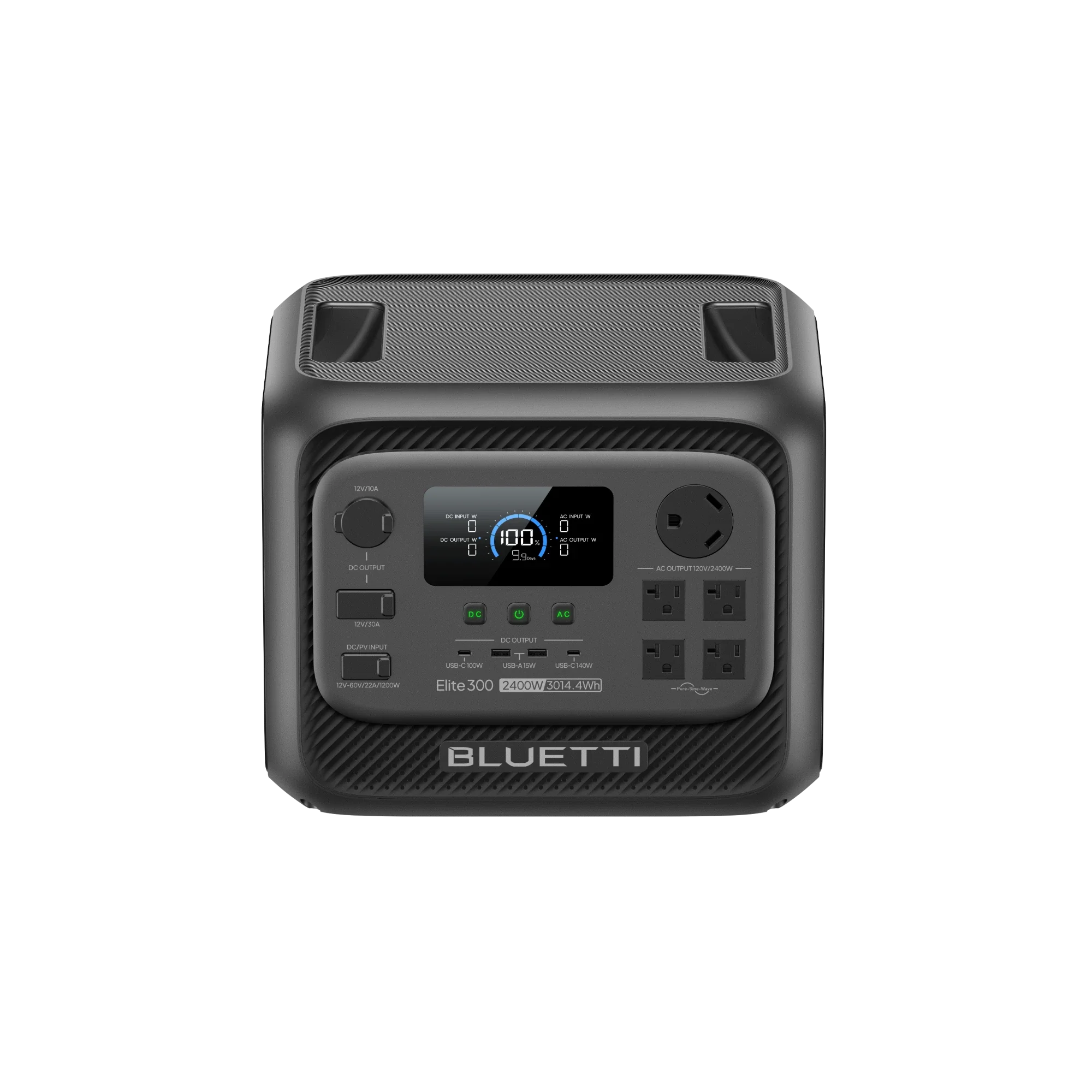
The Elite 300’s strongest argument is storing 3,014.4Wh in a relatively compact enclosure. At about 58 pounds, it is still a substantial object to load into a vehicle or move around a house. Small volume should not be mistaken for effortless lifting.
Compared with the Elite 200 V2, it offers about 45% more nominal energy but a lower AC output rating: 2,400W rather than 2,600W. That makes it worth considering for longer use of compatible loads, rather than as an automatic upgrade for more demanding appliances.
Review method: We assessed official BLUETTI specifications and the Elite 300 manual. We have not bought or bench-tested this model. Runtime examples are calculations, not measured results, and no performance score is assigned.
Reasons to consider it
- 3,014.4Wh of integrated LFP storage.
- US TT-30 outlet for compatible RV hookups.
- 12V/30A output for appropriately wired DC devices.
- 100W and 140W USB-C connections.
- Up to 1,200W DC/solar input.
- 10ms UPS specification and app control.
Tradeoffs to weigh
- 2,400W maximum AC output.
- About 58 pounds despite the compact body.
- No direct expansion-battery connection listed.
- Solar and car cables are separate from the base kit.
- Charger 2 is an additional vehicle-charging accessory.
- US bypass power is limited to 1,800W.
Know what you are buying
The important specifications.
| Battery | 3,014.4Wh · LiFePO₄ (LFP) |
|---|---|
| AC output, US | 2,400W maximum · 120V |
| Power Lifting | Up to 4,800W appliance rating for compatible pure resistive loads; reduced operating power |
| US AC connections | Four household outlets plus a TT-30 RV outlet; shared AC power budget |
| USB-C | One 100W port and one 140W port |
| USB-A | Two ports, 15W total according to the manual |
| 12V DC | 10A car outlet and 30A high-current output, sharing 30A total |
| AC charging, US | Up to 1,800W · 120V / 15A |
| DC / solar input | Up to 1,200W · 12–60V · 22A |
| Combined AC + DC input | Up to 2,400W |
| UPS transfer | 10ms specified; compatibility depends on the connected device |
| Weight | About 57.98 lb (26.3 kg) |
| Dimensions | 14.41 × 12.01 × 11.71 in (366 × 305 × 297.5 mm) |
| Cycle-life claim | 6,000+ cycles advertised by BLUETTI; not a calendar-life guarantee |
| Environment | IP20; keep dry. Charging: 32–104°F. Discharging: −4–104°F. |
Reference: Elite 300 manual V2.0, section 11, and the US product listing. The US layout totals eleven output connections; regional layouts differ.
For RV owners
An RV socket.
The same 2,400W limit.
The TT-30 connector simplifies plugging in a compatible 120V RV shore-power lead. It does not deliver the full 3,600W associated with 120V/30A shore power: the station’s total AC output remains 2,400W. Manage simultaneous loads such as a microwave, water heater, and air conditioner accordingly.
For an air conditioner, compare running demand and documented startup requirements with the station’s normal output capabilities. A compatible soft-start device may help some installations, but it does not guarantee startup. The 4,800W Power Lifting figure is for suitable pure resistive loads, rather than a general compressor-starting allowance.
A properly matched direct-DC connection can avoid running a battery inverter and then an appliance’s AC adapter. Conversion and cable losses still exist, and savings depend on the complete setup. Many other stations also include usable DC outlets; the Elite 300’s advantage is the higher-current option, not exclusive access to DC power.
Use the correct cable, connector, polarity, protection, and wire rating for each DC device. Supplying an RV’s fixed DC wiring is an installation task, not simply plugging an unfused lead into a convenient port. Confirm the RV’s grounding and shore-power requirements too.
Refilling the battery
Check the supply.
Budget for the cables.
The US manual lists 1,800W maximum AC charging and 1,200W maximum DC input, with a 2,400W combined ceiling. These are limits, not constant charging rates. Battery state, temperature, selected charging mode, connected loads, and available input affect the actual rate.
Solar input must stay within 12–60V and 22A. Check panel open-circuit voltage, including its increase in cold conditions, before choosing a series string. Panel wattage alone does not establish electrical compatibility.
The current station-only box list contains the unit, AC charging cable, grounding screw, and manual. Solar and car charging cables are optional purchases. A bundle may include additional items, so compare the exact packing list rather than assuming every pictured accessory ships with the station.
The 1,200W vehicle-and-solar charging headline uses the separate Charger 2 accessory and a supported installation. It is not the rate you obtain from a standard cigarette-lighter socket. Price the charger, wiring, and any installation work as part of the complete setup.
References: manual sections 2, 4.2, and 11; current US bundle and accessory listing.
Illustrative, not measured
Estimate from average load.
These scenarios assume 85% of nominal capacity is available for the AC load and station overhead, with an additional illustrative 10W operating allowance. Those are editorial planning assumptions, not measured Elite 300 efficiency or manufacturer-certified runtime. They show how strongly the answer changes with average demand.
| Average AC load | Calculated scenario |
|---|---|
| 60W | 36.6 hours |
| 120W | 19.7 hours |
| 200W | 12.2 hours |
| 800W | 3.2 hours |
| 1,000W | 2.5 hours |
| 1,500W | 1.7 hours |
| 2,400W | 1.1 hours |
Scenario formula: 3,014.4 × 0.85 ÷ (average AC load watts + 10). Full starting battery, no incoming charge. Actual overhead, losses, battery condition, temperature, and settings differ. This is not a DC/USB runtime model or a guaranteed upper or lower bound.
For refrigeration, measure energy over a representative period. Compressor cycling, ambient temperature, and door openings change the average; there is no universal “two or three times longer” multiplier. For a microwave, use electrical input power rather than the cooking-wattage headline.
Solar or vehicle input can extend operation when it supplies useful energy. It cannot be assumed to keep the battery full in every setting. Match daily consumption with realistic recharge opportunities, especially for cooling or heating.
Choosing the right model
Capacity, output, or expansion?
| Model | Nominal energy | Rated AC output | Main distinction |
|---|---|---|---|
| Elite 200 V2 | 2,073.6Wh | 2,600W | Less storage, higher AC rating |
| Elite 300 | 3,014.4Wh | 2,400W | US RV outlet and 12V/30A option |
| APEX 300 | 2,764.8Wh base | 3,840W | US 120V/240V and expansion paths |
Choose the Elite 300 when its integrated capacity and connections match your measured loads. Choose a higher-output station when demand requires it, and an expandable system when the required energy reserve is likely to grow. Compare current complete-system prices rather than assuming one model always costs less.
Before ordering
Compare the complete offer.
Confirm the US Elite 300 model, included cables, panel compatibility, delivery, return policy, and warranty. Price a station-only package against bundles that include the accessories you actually need.
Our shopping link opens BLUETTI’s store. Select the Elite 300 there and verify the current offer; we do not print a sale price that may change.
Browse BLUETTI Affiliate link · Opens the BLUETTI storeQuestions answered
Elite 300 FAQ.
Does TT-30 mean a full 30A RV supply?
No. The connector is an RV convenience; total AC output remains 2,400W. The US manual also lists 1,800W maximum AC bypass output. Check the limits of the actual operating mode.
Will it start my RV air conditioner?
That depends on the specific air conditioner, startup demand, and installation. A soft-start may help, but Power Lifting is not a universal compressor-starting surge allowance. Confirm compatibility before relying on it.
Can I add an expansion battery?
No direct expansion-battery connection is listed for the Elite 300. Its integrated nominal capacity is 3,014.4Wh. External charging is different from integrated capacity expansion; consider the APEX platform if expansion is central to your plan.
Will 10ms UPS prevent every reboot?
No transfer-time rating guarantees compatibility with every power supply. Check your device’s requirements and verify the setup. The manual lists a separate 1,800W US bypass limit and cautions against using Grid Self-Adaption mode for devices that require a high-performance UPS.
Do USB ports need an extra hub?
No. The Elite 300 includes 100W and 140W USB-C ports, plus two USB-A ports sharing 15W according to the manual. Actual charging speed depends on the device and cable.
Is it the world’s smallest 3kWh station?
BLUETTI advertises a Frost & Sullivan certification for that claim. This review does not independently verify the certification or the entire market. The documented dimensions and roughly 58-pound weight are the more useful checks for your storage and transport plan.
Does DC operation eliminate all losses?
No. A compatible direct-DC connection can skip the AC inverter and adapter path, but regulation, wiring, and other losses remain. The actual improvement depends on the appliance and connection.
Sources and review method.
Official documentation checked September 16, 2026. This is an editorial assessment of published specifications, not hands-on testing. Runtime figures are illustrative calculations. Follow the current manual for the exact regional model and firmware.
- BLUETTI Elite 300 US listing — model features, cycle-life claim, accessories, and official image.
- Elite 300 user manual V2.0 — electrical limits, charging, Power Lifting, and UPS operation.
- Elite 200 V2 specifications and APEX 300 specifications — comparison ratings.